
Omsk On The Right (Part 2)
Now, at the Omsk Hermitage Art Museum, an old believer has a showing of his artwork. And he's rather well known:Viktor Kalinin is one of the masters who defined the image of Russian art in the second half of the 20th and early 21st centuries. His works are featured in the collections of the most famous Russian museums, including the Tretyakov Gallery and the Russian Museum.The artist was born in 1946 in the Altai Territory, in the village of Zalesovo. In 1960-1962, he studied at the Surikov Art School in Krasnoyarsk, and in 1971, he graduated from the Moscow Higher Art and Industrial School (formerly the Stroganov School), Department of Monumental Painting. Member of the Moscow Union of Artists (1975); Full Member of the Russian Academy of Arts (2007); Member of the Presidium of the Russian Academy of Arts (2012); First Vice-President of the Russian Academy of Arts (2017); Honored Artist of the Russian Federation (2013). Participant of international art symposiums and art salons in the UK, Hungary, Denmark, Norway, Poland, the USA, France, and Switzerland.So, I'm looking forward to taking a look today at his works when the museum opens at 10am.This is not the run-of-the-mill talented or even very talented artist. Here is an extraordinary artist! Monumental indeed describes his works. Abstract modernism, cubism, and impressionism seem all mixed in here, but at no point does the viewer feel lost. Mystery is there, but not in meaning. Also, if you look and look again, you'll see a collage of different actions happening in the cavnas. Balance is achieved in all, including a balance of color. Electric greens and purples, mauves, but all in strong lines with very little muting. Pure colors achieve power. Many Biblical scenes can be found here, including 'The Flight to Egypt' and the Annunciation. A seriousness exists here, nothing of a French Impressionist genre, which catches the flimsy moment just for its own sake. No, here are ponderous themes, weighty, and structured. Not beautiful, and yet very beautiful.The author, growing up in the Altai area of Siberia, describes his own work and history and described himself as being surrounded by icons as a child. Both of his other brothers wanted to be artists, but the older brother, after completing art school, died in the army. Maybe icons helped him choose his color palette, as he uses primary and secondary colors with little muting and no attempt to galvanize the human body into anything close to seduction. And yet the figures have power and beauty! No wonder his works are in the best galleries! Again, I'm very glad to have the opportunity to explore world-class art so easily in Omsk. This exhibition is temporary and is traveling through many other major cities.
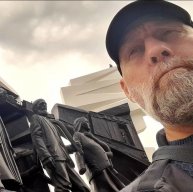
Now, at the Omsk Hermitage Art Museum, an old believer has a showing of his artwork. And he's rather well known:Viktor Kalinin is one of the masters who defined the image of Russian art in the second half of the 20th and early 21st centuries. His works are featured in the collections of the most famous Russian museums, including the Tretyakov Gallery and the Russian Museum.The artist was born in 1946 in the Altai Territory, in the village of Zalesovo. In 1960-1962, he studied at the Surikov Art School in Krasnoyarsk, and in 1971, he graduated from the Moscow Higher Art and Industrial School (formerly the Stroganov School), Department of Monumental Painting. Member of the Moscow Union of Artists (1975); Full Member of the Russian Academy of Arts (2007); Member of the Presidium of the Russian Academy of Arts (2012); First Vice-President of the Russian Academy of Arts (2017); Honored Artist of the Russian Federation (2013). Participant of international art symposiums and art salons in the UK, Hungary, Denmark, Norway, Poland, the USA, France, and Switzerland.So, I'm looking forward to taking a look today at his works when the museum opens at 10am.This is not the run-of-the-mill talented or even very talented artist. Here is an extraordinary artist! Monumental indeed describes his works. Abstract modernism, cubism, and impressionism seem all mixed in here, but at no point does the viewer feel lost. Mystery is there, but not in meaning. Also, if you look and look again, you'll see a collage of different actions happening in the cavnas. Balance is achieved in all, including a balance of color. Electric greens and purples, mauves, but all in strong lines with very little muting. Pure colors achieve power. Many Biblical scenes can be found here, including 'The Flight to Egypt' and the Annunciation. A seriousness exists here, nothing of a French Impressionist genre, which catches the flimsy moment just for its own sake. No, here are ponderous themes, weighty, and structured. Not beautiful, and yet very beautiful.The author, growing up in the Altai area of Siberia, describes his own work and history and described himself as being surrounded by icons as a child. Both of his other brothers wanted to be artists, but the older brother, after completing art school, died in the army. Maybe icons helped him choose his color palette, as he uses primary and secondary colors with little muting and no attempt to galvanize the human body into anything close to seduction. And yet the figures have power and beauty! No wonder his works are in the best galleries! Again, I'm very glad to have the opportunity to explore world-class art so easily in Omsk. This exhibition is temporary and is traveling through many other major cities.